Searching for Cincinnati cabinet services? You’re already ahead of the curve. Cabinet refacing is one of the highest-value upgrades a homeowner can make — refreshing every visible surface of your kitchen cabinets for a fraction of the cost and time of a full replacement. This complete guide walks you through exactly what cabinet refacing involves, what it costs, how to vet local specialists, what questions to ask, and what mistakes to avoid so you get the best possible result.
What Is Cabinet Refacing and How Does It Work?
Cabinet refacing is the process of replacing the visible front surfaces of your kitchen cabinets — doors, drawer fronts, and hardware — while leaving the existing cabinet boxes (the frames attached to your walls) in place. A new veneer or laminate is applied over the exterior faces of those frames, producing a completely transformed look without the cost, waste, or disruption of ripping everything out. Learn more about custom cabinet refacing options and door styles.
The process is distinct from painting (which applies color to existing surfaces), refacing is distinct from restyling (which may also include adding decorative elements like glass inserts or crown molding), and it is entirely different from replacement (which removes and rebuilds the entire cabinet structure). Understanding these differences helps you communicate clearly with any cabinet refacing company near you and ensures you get an accurate quote.
According to the HGTV Kitchen Remodeling Guide, cabinet refacing costs 40–50% less than full cabinet replacement. For most homeowners, that difference represents thousands of dollars in savings — money that can go toward new countertops, appliances, or flooring instead.
The Cabinet Refacing Process: Step by Step
Understanding exactly what happens during a refacing project eliminates surprises and helps you prepare your home. Here is what a professional installation typically involves: refacing process guide
- Cabinet assessment: The refacing specialist inspects your existing cabinet boxes for structural integrity — warping, water damage, or pest damage would need to be addressed before refacing can begin.
- Old door and hardware removal: All existing doors, drawer fronts, and hardware are removed and set aside for disposal.
- Surface preparation: The exposed exterior faces of cabinet frames are cleaned, sanded, and prepped for adhesion.
- Veneer or laminate application: A matching veneer (real wood or synthetic laminate) is precision-cut and adhered to all visible frame surfaces, including edges and sides.
- New door and drawer front installation: Your chosen door style is measured, cut, and mounted on concealed or exposed hinges.
- Hardware installation: New knobs, pulls, and hinges are installed to complete the transformation.
- Final inspection and cleanup: The team does a walkthrough with you to confirm alignment, finish consistency, and overall satisfaction before leaving.
From start to finish, most residential cabinet refacing projects are completed in two to four days — a dramatically shorter timeline than full replacement, which can take two to six weeks or more.
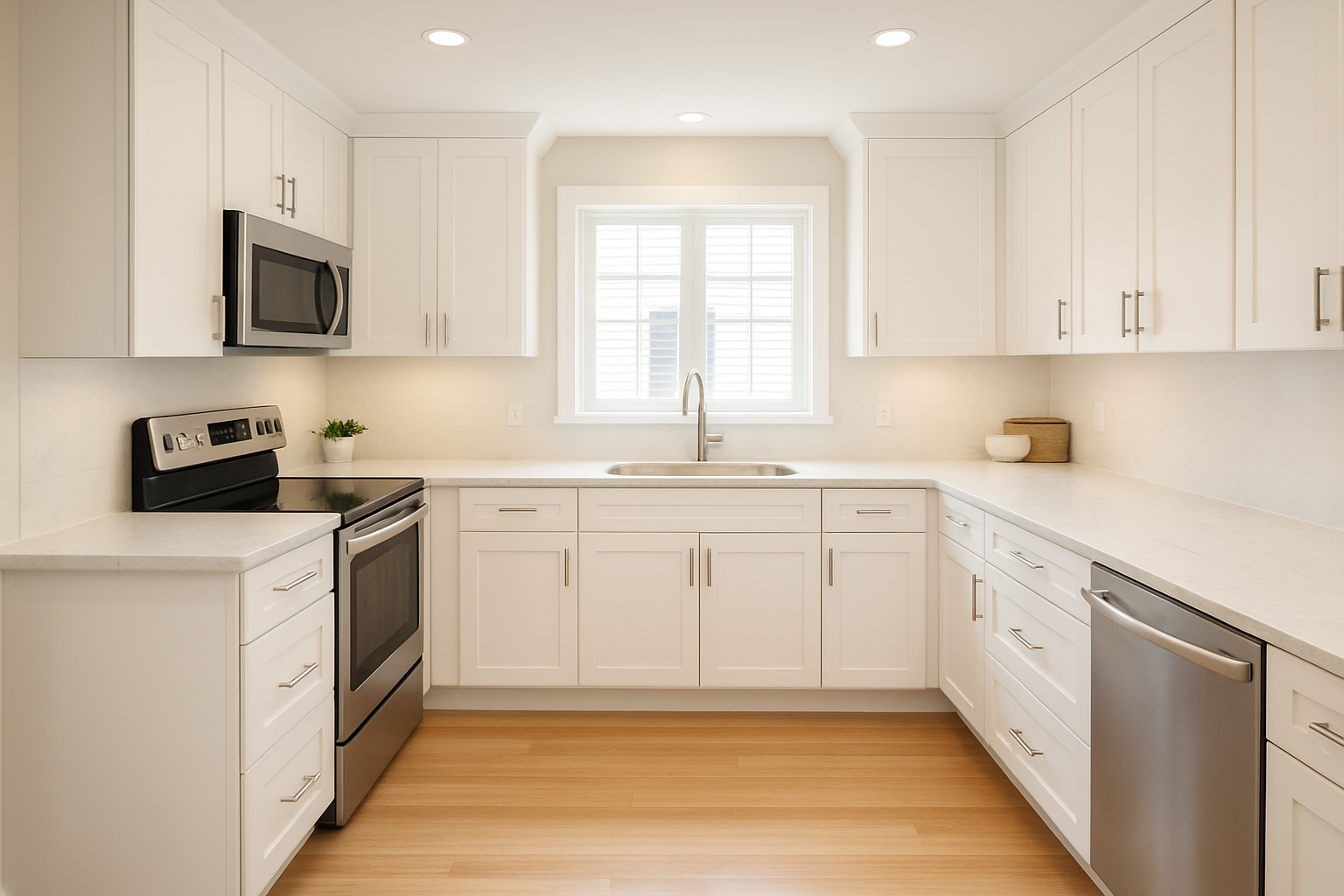
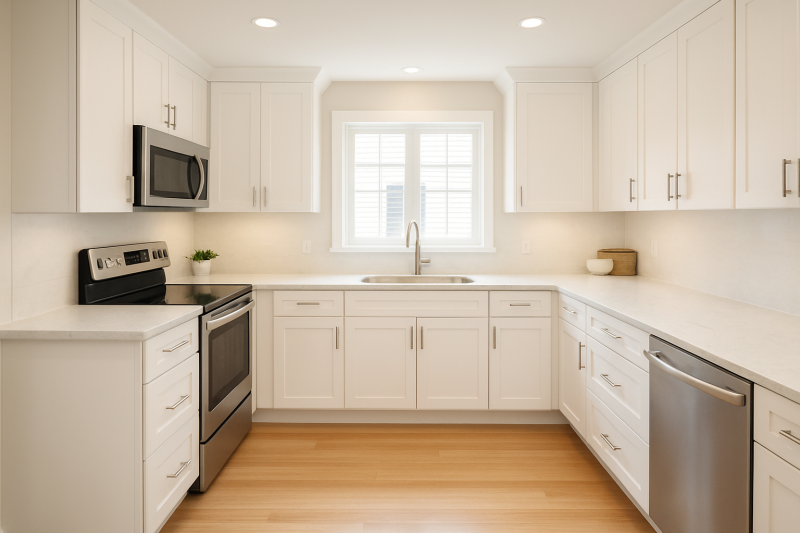
Local cabinet refacers near me can deliver a stunning shaker-style transformation like this — typically in just two to four days.
Cabinet Refacing vs. Replacement vs. Painting: Which Is Right for You?
Before you search for local cabinet refacers, it helps to confirm that refacing is the right solution for your situation. Here is how the three most common cabinet update options compare:
Refacing is the ideal choice when: your cabinet boxes are structurally sound, you want a dramatic visual transformation, your budget doesn’t stretch to full replacement, and you need minimal kitchen downtime. If your cabinets have severe water damage, you want to change the layout, or the boxes are beyond salvage, full replacement may be necessary.
Cabinet Refacing Materials and Door Styles: What Local Companies Offer
One of the biggest advantages of working with a experienced cabinet refacers near you — rather than a general contractor — is access to a wider, more curated selection of materials and door profiles. Here is what to expect:
Veneer and Frame Covering Options
- Real wood veneer: Thin slices of genuine hardwood (oak, maple, cherry, walnut) adhered to the cabinet frame. Offers an authentic wood grain appearance and can be stained or finished to match new door fronts precisely.
- Rigid thermofoil (RTF): A durable vinyl film heat-pressed over a medium-density fiberboard (MDF) core. RTF is moisture-resistant, easy to clean, and available in dozens of colors and textures — including realistic wood grain replicas.
- High-pressure laminate (HPL): Extremely durable and scratch-resistant. Laminate comes in a broad spectrum of colors and patterns and is especially popular in contemporary kitchens.
- Melamine: A budget-friendly, moisture-resistant option typically available in solid colors or basic wood patterns.
Popular Door Styles Available from Local Cabinet Refacers
- Shaker: A five-piece door with a recessed center panel — the most universally popular style, equally at home in traditional, transitional, and modern kitchens.
- Raised panel: A classic, traditional look with a center panel that protrudes slightly, adding visual depth and dimension.
- Flat-front / slab: A single solid piece with no frame or panel detail — the go-to for contemporary and minimalist kitchens.
- Beadboard: Features vertical groove detailing for a cottage or farmhouse aesthetic.
- Glass-insert doors: A popular upgrade during refacing that opens up uppers visually and allows display of dishware.
- Arched / cathedral: A decorative top rail with a curved profile — ideal for traditional or Mediterranean-influenced kitchens.
Hardware: The Finishing Touch
Updating handles, knobs, and hinges during a refacing project is one of the most cost-effective ways to sharpen the final result. Most cabinet refacing companies near you will offer hardware options as part of the project package or allow you to supply your own. Popular finishes include brushed nickel, matte black, oil-rubbed bronze, and polished chrome. Even a modest hardware upgrade can make the entire kitchen feel deliberately designed rather than simply refreshed.
How to Find and Hire Reliable Cabinet Refacers Near Me
Vetting local cabinet refacing companies is not difficult when you follow a structured approach. Use this step-by-step process to move from initial search to signed contract with confidence.
- Search specifically for cabinet refacing specialists — not general contractors. Use search terms like “cabinet refacers near me,” “kitchen cabinet refacing company,” or “local cabinet refacing specialist.” Companies that focus exclusively on refacing tend to carry broader material selections, more experienced installers, and tighter project timelines.
- Evaluate online reviews and photo portfolios. Look for verified Google reviews, before-and-after photo galleries, and evidence of completed work in your specific region. Be skeptical of companies with no photos or reviews posted within the past 12 months.
- Request in-home estimates from at least two to three companies. A legitimate cabinet refacing specialist will always assess your cabinets in person before quoting. Remote or phone-only quotes are a red flag. During the visit, note how thoroughly they inspect the cabinet boxes and how clearly they explain your options.
- Compare proposals side by side — materials, warranty, timeline, and price. Do not evaluate on price alone. A lower bid may reflect thinner veneer material, fewer door style options, shorter warranty coverage, or subcontracted labor. Ask each company to specify the brand and grade of materials in their written quote.
- Verify licensing, insurance, and credentials. Confirm that the contractor holds a valid state contractor’s license and carries both general liability insurance and workers’ compensation coverage. Request copies — a reputable company will provide them without hesitation.
- Ask for local references — and actually call them. Request two or three references from recent projects in your area and follow through. Past clients can confirm whether the company showed up on time, communicated clearly, completed on schedule, and stood behind their work.
- Review the contract in full before signing. Every scope-of-work item should be in writing: specific materials by name and grade, door styles, hardware selections, project start and completion dates, payment schedule, and warranty terms. Never proceed on a verbal agreement alone.
- Prepare your kitchen before the crew arrives. Clear countertops, remove items from inside all cabinets, and protect nearby appliances. This allows the refacing team to begin work immediately on day one and keeps the project on schedule.
Key Questions to Ask Every Local Cabinet Refacing Company
Walk into every consultation with this question list ready:
- How many years have you been doing cabinet refacing specifically (not general contracting)? For a deeper walkthrough, see our Cabinet Experts Cincinnati: Top Refacing Services.
- What brands and grades of veneer and door materials do you use?
- Do you have a showroom or physical sample library I can visit?
- Who will actually perform the installation — your own employees or subcontractors?
- What warranty do you offer on materials and labor, and how do I make a claim if needed?
- How do you handle cabinet boxes that show hidden damage during the project?
- Can you show me completed projects similar to my kitchen size and style?
- What is your payment schedule, and do you require a deposit up front?
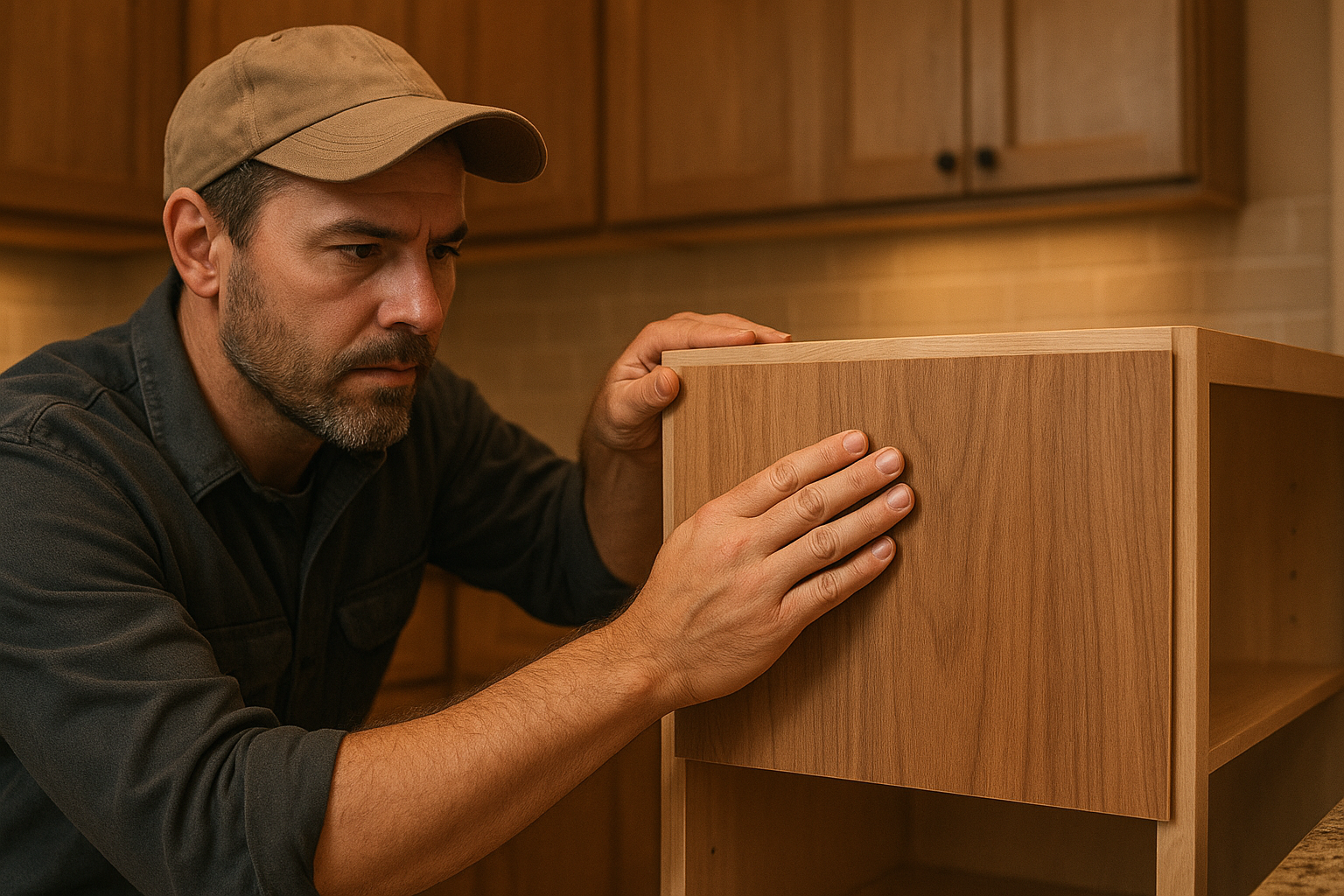
A skilled local cabinet refacing professional applies fresh veneer to existing frames — preserving structure while delivering a completely new look.
Cabinet Refacing Cost: What to Expect in Your Area
Cost is the first question most homeowners ask, and for good reason. According to HomeAdvisor’s cabinet refacing cost guide, the national average ranges from $4,000 to $10,000 for a typical kitchen — compared to $12,000 to $30,000 or more for full cabinet replacement. That’s a savings of 40–60% for a comparably dramatic visual result.
What Drives the Cost of Cabinet Refacing?
- Number of cabinet doors and drawer fronts: More doors and drawers directly increase material and labor costs. A small galley kitchen with 10 doors will cost noticeably less than an open-plan kitchen with 25 doors.
- Material selection: Solid hardwood doors are the most expensive option. RTF and laminate cost less upfront while still delivering a polished, durable result. The veneer applied to the frames follows similar pricing tiers.
- Door style complexity: Simple flat-slab doors cost less to produce than raised-panel or glass-insert doors, which require additional machining or fabrication.
- Hardware upgrades: Basic hardware is typically included in refacing packages. Designer or premium hardware (soft-close hinges, European-style mechanisms, custom pulls) adds to the total.
- Cabinet box repairs: If any boxes need reinforcement, hinge plate replacement, or damage repair before refacing begins, those costs are added separately.
- Regional labor rates: Labor costs vary meaningfully by geography. Contractors in high cost-of-living metropolitan areas will quote higher than those in smaller markets — which is precisely why getting multiple local estimates is essential.
- Add-on services: Soft-close drawer slides, lazy Susan replacements, pull-out shelf installations, or interior cabinet lighting can be bundled into a refacing project for added cost.
Pro tip: Online cabinet refacing cost calculators give rough ballpark figures only. A Cincinnati refacing services specialist who visits your kitchen in person can provide a far more accurate quote that accounts for your specific cabinet count, layout, and material preferences. Always request a written itemized estimate.
Typical Cabinet Refacing Cost Ranges by Kitchen Size
Does Cabinet Refacing Add Value to Your Home?
This is one of the most frequently asked questions — and the answer is a qualified yes. While cabinet refacing does not produce the same ROI as a full kitchen remodel in every market, it delivers strong value in several measurable ways.
- Improved first impression: The kitchen is consistently cited by real estate professionals as the single most influential room for buyers. A fresh, modern kitchen appearance — even without full renovation — can meaningfully accelerate a sale.
- Competitive asking price support: Refaced cabinets allow sellers to present the kitchen as “updated” in listings, which supports pricing at or above comparable homes with dated cabinetry.
- High ROI relative to cost: Because refacing costs a fraction of full replacement, the return-on-investment ratio is often more favorable — especially in mid-range markets where buyers aren’t expecting luxury-level finishes.
- Personal lifestyle value: Even if you’re not planning to sell, an updated kitchen improves daily quality of life. That’s a return that doesn’t show on a spreadsheet but matters enormously to the people living in the home.
Is Cabinet Refacing Right for You? Signs It Is — and Signs to Consider Alternatives
Refacing Is the Right Choice When:
- Your cabinet boxes are solid, plumb, and free of significant water damage or structural compromise
- You are satisfied with the current layout and don’t need to move, add, or remove cabinets
- You want a dramatically updated look without the cost or disruption of full replacement
- You need the kitchen operational again within a few days
- You want an environmentally responsible option that avoids demolition waste
- You’re preparing a home for sale and want maximum visual impact within a defined budget
Consider Full Replacement When:
- Cabinet boxes show extensive water damage, mold, rot, or pest infestation
- You need a completely different kitchen layout — adding an island, changing the footprint, or relocating plumbing
- The current cabinet configuration is so poor that it impacts functionality beyond the cosmetic
- Your boxes are made of particleboard that has swelled or deteriorated beyond surface-level repair
Common Mistakes to Avoid When Hiring Cabinet Refacers Near Me
Even a straightforward refacing project can go sideways when homeowners skip critical due-diligence steps. Here are the most costly mistakes to avoid:
- Choosing based on price alone. The lowest quote frequently reflects thinner veneer materials, less experienced labor, or a shorter warranty period. Compare the full value — materials, craftsmanship, timeline, and warranty — not just the bottom line.
- Hiring a general contractor instead of a refacing specialist. General contractors who “also do refacing” typically offer a narrower material selection and less installation precision than companies whose entire business is cabinet refacing. Specialization matters.
- Skipping the written contract. Every project detail — material specifications, start and completion dates, payment schedule, warranty terms, and scope of work — must be in writing. Verbal commitments are unenforceable.
- Neglecting to check the box condition. A reputable refacing specialist will assess your cabinet boxes before committing to the project. If a contractor is willing to reface without inspection, that’s a warning sign — damaged boxes undermine the entire result.
- Not verifying insurance and licensing. Any damage to your home during the project is your problem if the contractor lacks proper insurance. Always request and verify current certificates of insurance before work begins.
- Skipping the reference check. Online reviews are helpful but not sufficient. Contacting actual past clients gives you candid insight into reliability, communication, and how the company handled any problems that arose.
- Forgetting to account for interior upgrades. If you want soft-close hinges, pull-out shelves, or lighting inside the cabinets, those need to be discussed before the project begins — not added as an afterthought that disrupts the schedule.
According to the National Kitchen and Bath Association (NKBA), engaging credentialed kitchen professionals with documented project experience substantially reduces the risk of costly errors and project delays.
The Environmental Case for Choosing Local Cabinet Refacers
Sustainability is an increasingly important factor for homeowners making renovation decisions — and cabinet refacing wins decisively on environmental grounds. When you reface rather than replace, you:
- Eliminate demolition waste: A full cabinet tearout generates hundreds of pounds of material — wood, laminate, fasteners, and adhesives — that typically goes straight to landfill. Refacing produces none of that waste.
- Reduce demand for virgin raw materials: New cabinet production requires harvesting, milling, finishing, and transporting raw wood. Refacing reuses the existing structural material already in place.
- Lower project carbon footprint: Less manufacturing, less transport, and less disposal means a meaningfully lower environmental impact for the overall project.
For homeowners who value responsible consumption, choosing a local cabinet refacer over a full replacement contractor is a decision that aligns financial savings with environmental responsibility.
Why Work With a Cincinnati-Area Cabinet Refacing Specialist
For homeowners in the greater Cincinnati area, Kitchen Transformations Cabinet Refacing brings a specialist’s focus to every project. Unlike general contractors who treat refacing as a side service, this team’s entire business is built around cabinet refacing — which translates into a deeper material library, more experienced installers, faster project timelines, and more personalized design guidance for each homeowner.
The benefit of working with a locally rooted specialist goes beyond technical skill. A team embedded in the Cincinnati market understands local home styles, the regional architectural mix of ranch homes, colonials, and contemporary builds, and what finishes and door profiles are most popular in the area. That local perspective leads to better recommendations and a result that feels right for the home — not just generically modern.
You can explore completed local projects in the project gallery to see the quality of finished work in kitchens similar to your own. Seeing real transformations — not staged photography — gives you a much more realistic expectation of what’s possible in your home.
What Sets a True Specialist Apart from a Generalist
- Wider selection of door styles, veneer species, and laminate colors from dedicated suppliers
- Installers who perform refacing daily — not occasionally — resulting in cleaner seams, tighter door alignment, and a more consistent finish
- A refined estimating process that catches potential box issues before project start, not during
- Warranty backed by a company whose reputation depends entirely on refacing quality
- A showroom or sample library where you can see and touch actual materials before committing
Frequently Asked Questions About Cabinet Refacers Near Me
What does cabinet refacing mean?
Cabinet refacing means replacing the doors, drawer fronts, and hardware of existing cabinets while applying a new veneer or laminate to the visible exterior frames. The internal box structure stays in place, dramatically reducing cost, timeline, and kitchen disruption compared to full cabinet replacement.
How do I find reliable cabinet refacers near me?
Search for “cabinet refacers near me” or “local cabinet refacing specialist” and filter results by verified reviews, before-and-after photo portfolios, and evidence of recent local work. Request in-home estimates from at least two to three companies, verify licensing and insurance, and check references from past clients before signing any contract. For decision help, see our choose a quality service checklist.
How much does cabinet refacing typically cost?
The national average for kitchen cabinet refacing ranges from $4,000 to $10,000, depending on cabinet count, material selection, door style complexity, hardware choices, and regional labor rates. This is typically 40–60% less than the cost of full cabinet replacement, which averages $12,000 to $30,000 or more.
How long does a cabinet refacing project take?
Most residential cabinet refacing projects are completed in two to four days. This is dramatically faster than full kitchen cabinet replacement, which typically requires two to six weeks and involves demolition, installation, and finishing phases.
Is cabinet refacing worth it compared to full replacement?
Yes — cabinet refacing is worth it when your cabinet boxes are structurally sound and you want a dramatic visual transformation without full replacement cost and disruption. It delivers a comparable aesthetic result at 40–60% less cost, with minimal kitchen downtime and a lower environmental footprint.
What materials are used in cabinet refacing?
Cabinet refacing uses real wood veneer, rigid thermofoil (RTF), high-pressure laminate (HPL), or melamine for door fronts and frame surfaces. Solid hardwood doors offer a premium look; RTF and laminate provide excellent durability and moisture resistance at a lower price point.
Can cabinet refacing change the layout of my kitchen?
No — cabinet refacing updates the appearance of your existing cabinets without altering the kitchen layout. If you need to relocate, add, or remove cabinets, a partial or full kitchen remodel is required. Refacing is a cosmetic and surface transformation, not a structural one. For a deeper walkthrough, see our Affordable Cabinet Refacing: The Complete Guide to Saving Big on Your Kitchen.
What questions should I ask a local cabinet refacing company?
Ask about years of experience in refacing specifically, the brands and grades of materials used, whether installation is done by employees or subcontractors, warranty terms and claim procedures, how hidden cabinet box damage is handled mid-project, and whether you can see a physical sample library or completed local projects similar to yours.
Does cabinet refacing add value to my home?
Yes — an updated kitchen appearance consistently improves perceived home value and buyer appeal. Real estate professionals routinely cite the kitchen as the most influential room for buyers. Refaced cabinets allow a home to be listed as “updated kitchen,” supporting a stronger asking price relative to comparable homes with dated cabinetry.
What is the difference between cabinet refacing and cabinet painting?
Cabinet painting applies a new coat of paint to existing door and frame surfaces. Cabinet refacing replaces the door and drawer fronts entirely and applies a new veneer or laminate to the frame. Refacing produces a more durable, longer-lasting, and visually polished result than paint, which is prone to chipping, peeling, and wear over time.
Are there eco-friendly benefits to cabinet refacing?
Yes — cabinet refacing is significantly more environmentally friendly than full replacement. By reusing the existing cabinet box structure, refacing eliminates demolition waste, reduces demand for virgin raw materials, and lowers the project’s overall carbon footprint. It is one of the most sustainable kitchen update options available.
Can I update my hardware during a refacing project?
Absolutely — most cabinet refacing projects include or accommodate hardware upgrades such as new handles, knobs, pulls, and soft-close hinges. Updating hardware alongside new doors and veneer is one of the most effective ways to create a cohesive, thoroughly modernized kitchen appearance.
What add-on services can be bundled into a cabinet refacing project?
Many local cabinet refacing companies offer add-on services including soft-close drawer slides, pull-out shelf installations, lazy Susan replacement, glass door insert upgrades, interior cabinet lighting, and crown molding or decorative trim additions. Discuss all desired upgrades during the consultation so they can be included in the initial estimate.
How do I know if my cabinets are good candidates for refacing?
Your cabinets are good candidates for refacing if the boxes are structurally sound, plumb, and free of significant water damage, mold, rot, or pest damage. A reputable local cabinet refacing specialist will assess the condition of your boxes during the in-home estimate and give you an honest recommendation based on what they find.
Ready to Find Cabinet Refacers Near You? Start Here.
Searching for cabinet refacers near me doesn’t have to mean sorting through a sea of generalists. Prioritize specialists, get written estimates, verify credentials, and ask every question on this page before signing anything.
If you’re in the Cincinnati area, contact Kitchen Transformations Cabinet Refacing for a free in-home estimate. The team will assess your cabinets, walk you through every material and style option, and provide a detailed written quote tailored to your kitchen and budget — with no pressure and no guesswork. Article by Kitchen Transformations Cabinet Refacing — see our author bio and credentials on the About page for installer experience and warranty details. Last updated July 8, 2026. By Kitchen Transformations Cabinet Refacing.