Eco-Friendly Cabinet Options for a Greener, Smarter Kitchen
Eco-friendly cabinet options are among the most impactful and financially intelligent upgrades a homeowner can make. Whether you are refreshing a Cincinnati kitchen or overhauling a dated layout, today’s green cabinet choices go far beyond simply picking a wood type — they encompass materials, finishes, processes, certifications, and waste management strategies that together determine the true environmental footprint of your project. Learn about kitchen cabinet design solutions to plan your project.
According to the U.S. Environmental Protection Agency, construction and demolition debris surpasses 600 million tons of waste in the United States annually — more than double all municipal solid waste combined. Kitchen renovations are a measurable contributor. Choosing smarter, greener cabinet solutions is one of the most direct ways to reduce your household’s share of that burden.
What Are Eco-Friendly Cabinet Options?
Eco-friendly cabinet options are kitchen cabinet solutions intentionally designed to reduce environmental harm at every stage — from raw material sourcing and manufacturing through installation and eventual end-of-life disposal. They span a wide spectrum: choosing responsibly harvested wood species, selecting cabinet processes that extend the useful life of existing structures, applying low-emission surface finishes, and specifying adhesives that don’t compromise indoor air quality.
Critically, a genuinely green cabinet upgrade isn’t about checking a single box. It considers what materials are used, how they are processed, what chemicals are applied, and how much construction waste the project generates. The most sustainable approach addresses all four dimensions simultaneously rather than optimizing one while ignoring the others.
The Environmental Cost of Standard Cabinet Replacement
A conventional full cabinet replacement discards structurally sound cabinet boxes — frames, shelves, toe kicks, and all — sending enormous volumes of wood and composite material to landfills. Manufacturing new cabinetry consumes timber, energy, adhesives, and finishing chemicals. Transportation from factory to distributor to installer adds carbon emissions. When you add it up, a standard rip-and-replace kitchen remodel carries a surprisingly heavy environmental toll before a single cabinet door is hung on the new units.
Understanding this full lifecycle cost is the essential starting point for anyone evaluating eco-friendly cabinet options with genuine seriousness.
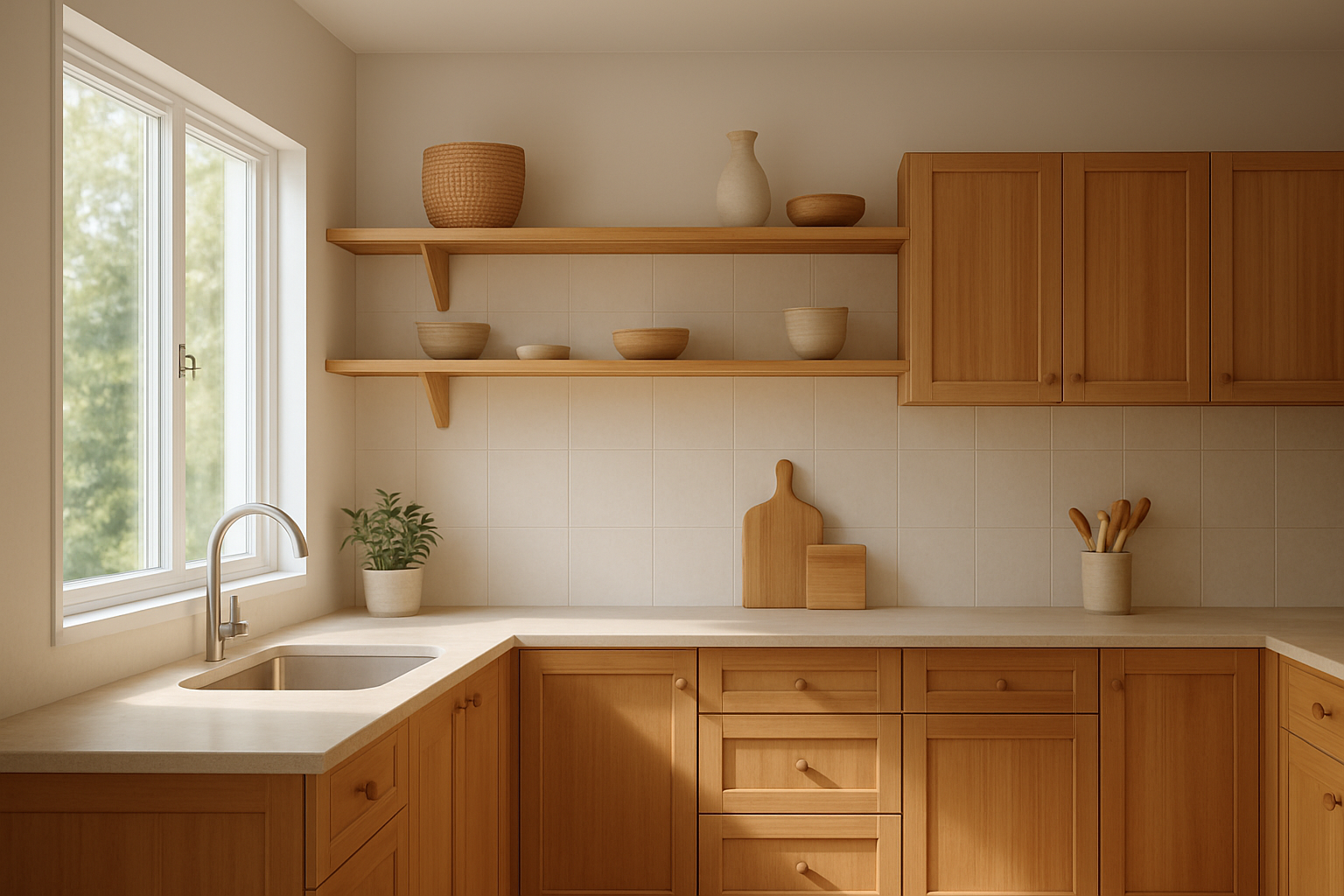
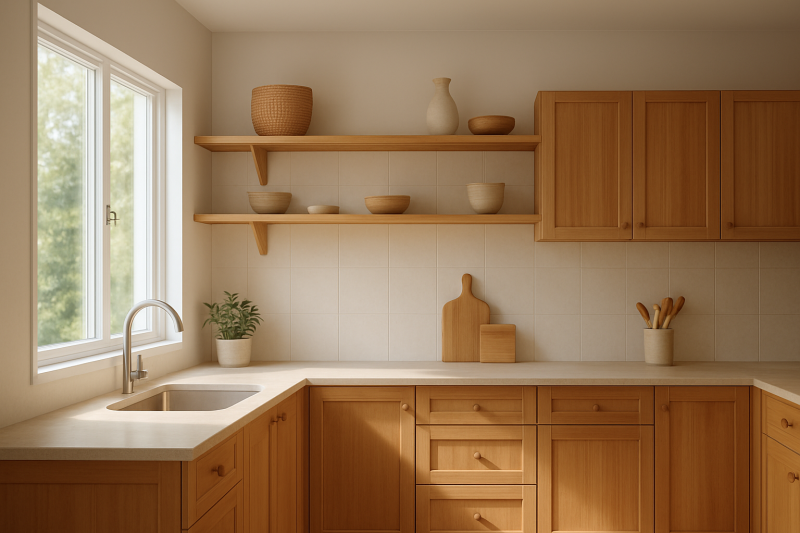
Eco-friendly cabinet options like natural wood and bamboo bring warmth and sustainability to any kitchen design. For a deeper walkthrough, see our Kitchen Design Consultation Guide for Cincinnati Homes.
Cabinet Refacing: The Greenest Kitchen Upgrade Available
Among all eco-friendly cabinet options, cabinet refacing delivers the single largest reduction in waste and resource consumption — and it does so at a dramatically lower cost than full replacement. For details, read our eco-friendly cabinet refacing guide. Refacing preserves the existing cabinet boxes entirely. Only the door fronts, drawer fronts, and visible exterior surfaces are updated with new materials. The structural skeleton of your kitchen stays exactly where it is.
This approach produces concrete environmental benefits that are difficult to match through any other kitchen upgrade path:
- Landfill diversion: Hundreds of pounds of wood and composite materials per kitchen project are kept out of the waste stream.
- Reduced raw material demand: Fewer trees are harvested, fewer engineered wood panels are produced, and less manufacturing energy is consumed.
- Lower carbon footprint: Minimal transportation and manufacturing activity compared to ordering and shipping entirely new cabinet sets.
- Shorter project timeline: Faster installation means fewer trips, less labor, and less disruption — all of which carry their own environmental overhead.
Kitchen Transformations Cabinet Refacing specializes in this kind of sustainable, waste-minimizing kitchen transformation for homeowners across the greater Cincinnati area. See our contemporary cabinet refacing options for modern finishes.
Cost Savings and Sustainability Together
Cabinet refacing typically costs 30 to 50 percent less than a full cabinet replacement. In practical terms, a project that would cost $20,000 in new cabinets might be accomplished for $10,000 to $14,000 through refacing — see the benefits of hiring a refacer. It is one of the rare home improvement decisions where doing the most environmentally responsible thing is also the most economically sensible choice.
What Refacing Results Actually Look Like
One common misconception is that refacing produces results that look “updated but not transformed.” In practice, professional cabinet refacing is visually indistinguishable from a full replacement. New door styles, fresh hardware, and updated surface veneers completely change the character of a kitchen. Browsing the Kitchen Transformations Cabinet Refacing gallery makes this clear: the finished results rival any full renovation at a fraction of the cost and environmental impact.
Sustainable Cabinet Materials: What to Look For and Why It Matters
Whether you are refacing existing cabinets or selecting materials for a new installation, the specific materials you choose have a significant impact on your project’s overall sustainability. Here is a detailed look at the most important eco-friendly cabinet materials available today:
FSC-Certified Wood
The Forest Stewardship Council (FSC) is the gold standard for responsible timber certification. FSC-certified wood is sourced from forests managed according to strict environmental, social, and economic standards — protecting biodiversity, respecting indigenous land rights, and preventing illegal logging. When you specify FSC-certified wood for cabinet doors or veneers, you have documented assurance that the timber was harvested responsibly.
Not all wood labeled “sustainable” carries independent FSC verification. Ask your contractor for chain-of-custody documentation, which traces the material from the certified forest through every stage of manufacturing to your kitchen. Without this documentation, sustainability claims are unverified marketing language.
Bamboo
Bamboo is technically a grass, not a wood — and that distinction matters enormously from a sustainability standpoint. Bamboo matures in just three to five years, compared to 25 to 80 years for most hardwood timber species. It regenerates from its own root system without replanting, produces no significant soil erosion, and sequesters carbon efficiently during its rapid growth phase.
As a cabinet material, bamboo is highly durable, naturally resistant to moisture and insects, and carries a Janka hardness rating comparable to red oak. It holds finishes well and is available in a range of natural and stained appearances. For homeowners seeking a genuinely renewable material that doesn’t sacrifice performance, bamboo is among the strongest choices in the eco-friendly cabinet options category.
Important note: Some bamboo products use formaldehyde-based adhesives in their lamination process. Always verify that bamboo cabinet materials carry CARB Phase 2 or GREENGUARD certification to ensure low chemical emissions.
Reclaimed and Recycled Wood
Reclaimed wood — timber salvaged from barns, factories, warehouses, and demolished structures — carries the lowest new-resource footprint of any wood cabinet material. No additional trees are harvested, no new forest land is disturbed, and a material that would otherwise become demolition waste is given a new functional life.
Beyond the environmental credentials, reclaimed wood carries aesthetic qualities that new timber simply cannot replicate: rich patina, natural weathering marks, nail holes, and color variation that give each kitchen a genuinely unique character. Reclaimed wood cabinets are a compelling eco-friendly option for homeowners who value both environmental integrity and distinctive design.
Practical considerations: availability varies by region, milling and preparation costs can push pricing to premium levels, and material dimensions may be non-standard. Working with a contractor experienced in reclaimed materials is essential for a smooth project.
CARB-Compliant Composite and Engineered Wood
Many cabinet boxes and door cores are constructed from engineered wood products such as medium-density fiberboard (MDF), particleboard, or plywood. These materials are manufactured using wood fiber, sawdust, and adhesive resins — and the adhesives are where the environmental and health concern lies. Many conventional engineered wood products use urea-formaldehyde resins that off-gas formaldehyde for years after installation, degrading indoor air quality and posing respiratory health risks.
CARB Phase 2 compliance, enforced by the California Air Resources Board, sets strict limits on formaldehyde emissions from composite wood products. CARB-compliant panels emit significantly less formaldehyde than non-compliant alternatives. For cabinet projects where engineered wood is unavoidable — as it often is — CARB compliance is the minimum standard to specify.
Thermally Modified Wood
An emerging option worth knowing: thermally modified wood is lumber that has been heat-treated at high temperatures without any chemical additives. The thermal modification process alters the wood’s cellular structure, dramatically improving its resistance to moisture, rot, and insects — without the toxic preservatives used in conventional pressure-treated wood. The result is a highly durable, dimensionally stable cabinet material with no chemical off-gassing concerns. Thermally modified wood is increasingly available for cabinetry and is a strong choice where durability in high-humidity environments is a priority.
Low-VOC and Zero-VOC Cabinet Finishes: Protecting Your Home’s Air Quality
Sustainable material selection is only half the equation. Even the most responsibly sourced cabinet wood can become a significant indoor air quality problem if coated with high-VOC (volatile organic compound) paints, stains, or lacquers. VOCs are chemical compounds that evaporate at room temperature and enter the air you breathe — often long after the installation crew has left.
According to the EPA’s Indoor Air Quality guidance, VOC concentrations indoors can be two to five times higher than outdoor levels — and up to ten times higher during and after renovation activities. Symptoms associated with VOC exposure include headaches, eye and throat irritation, nausea, and in cases of prolonged high-level exposure, liver and central nervous system effects.
What to Specify for Finishes
- Low-VOC paints and stains: Defined as containing fewer than 50 grams per liter of VOCs for flat finishes; look for products clearly labeled and independently tested.
- Zero-VOC finishes: Contain less than 5 grams per liter; the safest option for indoor air quality and available from most major professional finishing suppliers.
- Water-based lacquers: Dramatically lower VOC content than solvent-based equivalents, with comparable durability when properly applied.
- Natural oil finishes: Linseed, tung, and hardwax oils provide a beautiful, low-toxicity surface treatment. They require periodic re-application but produce no significant off-gassing after curing.
- GREENGUARD-certified products: GREENGUARD certification from UL Environment verifies that finishes, adhesives, and sealants meet strict chemical emission standards for indoor use. GREENGUARD Gold certification carries even more stringent limits, specifically designed for sensitive environments like schools and healthcare facilities.
When discussing your project with a contractor, explicitly request documentation of the specific finish products being used — not just a general assurance that they are “low-VOC.” The difference between 50 g/L and 5 g/L is significant for your family’s health.
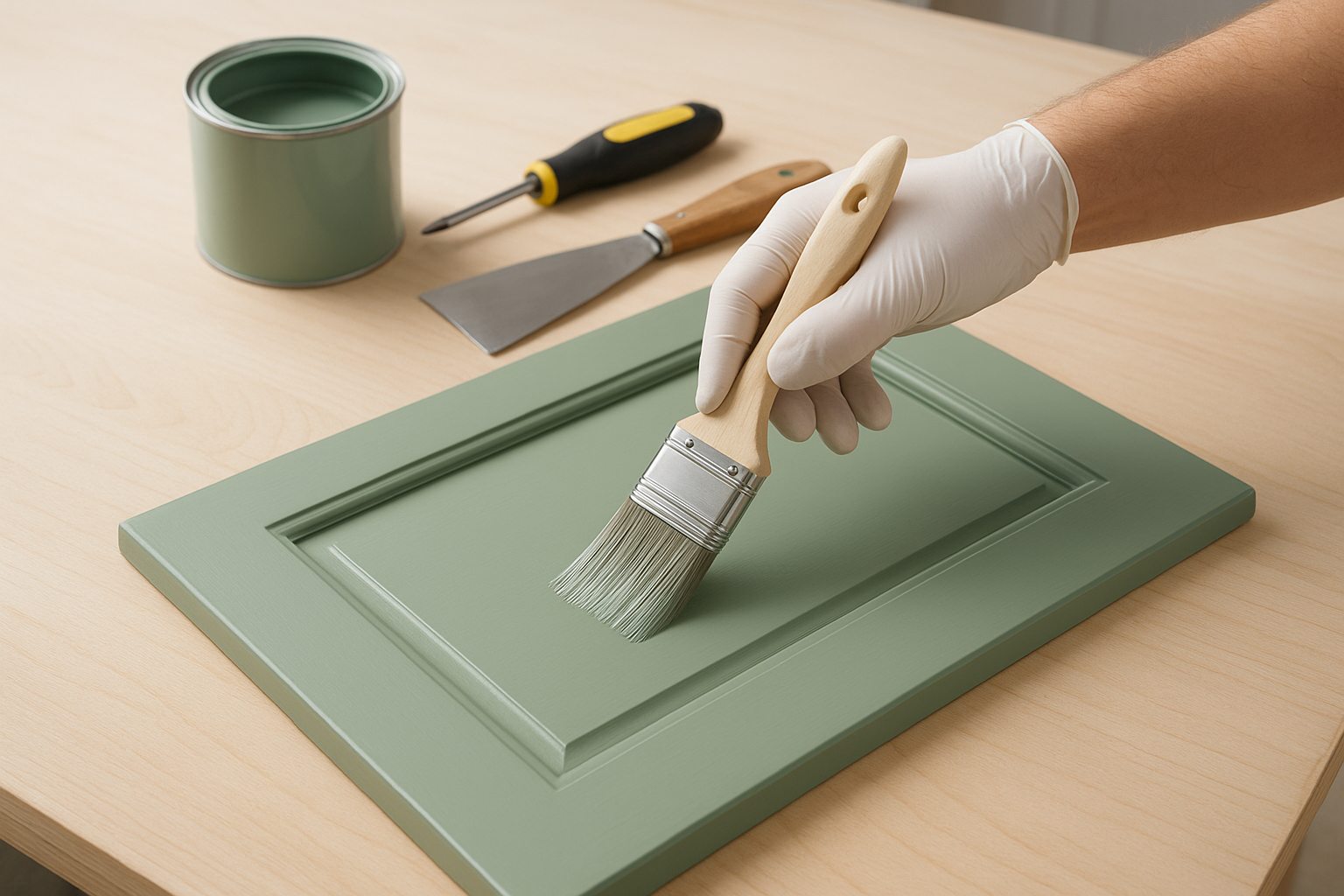
Low-VOC finishes are a key component of any genuinely sustainable cabinet project, protecting both your family and the environment.
Understanding Green Certifications for Cabinet Materials
Certifications are the clearest way to verify that a cabinet material or product meets an independently audited environmental or health standard. Here is a comprehensive breakdown of every major certification relevant to eco-friendly cabinet options:
| Certification | Issued By | What It Verifies | Apply To |
|---|---|---|---|
| FSC | Forest Stewardship Council | Responsible forest management and chain of custody | Solid wood, veneers, plywood |
| CARB Phase 2 | California Air Resources Board | Low formaldehyde emissions from composite wood | MDF, particleboard, plywood |
| GREENGUARD | UL Environment | Low chemical emissions for indoor air quality | Finishes, adhesives, panels |
| GREENGUARD Gold | UL Environment | Stricter emission limits; appropriate for sensitive populations | Finishes, adhesives, panels |
| Cradle to Cradle | Cradle to Cradle Products Innovation Institute | Full lifecycle sustainability — material health, reutilization, renewable energy use | Cabinet panels, finished goods |
| LEED Credit Eligibility | U.S. Green Building Council | Materials contribute to LEED certification points in green building projects | FSC wood, low-VOC products |
Always request actual certification documentation from your contractor — not verbal assurances. A reputable professional will readily provide chain-of-custody certificates, CARB compliance sheets, or GREENGUARD certification numbers for any product being installed in your home.
Comparing Eco-Friendly Cabinet Options at a Glance
| Option | Waste Reduction | Cost vs. Replacement | Renewable Material | Sustainability Rating |
|---|---|---|---|---|
| Cabinet Refacing | Very High | 30–50% savings | N/A (preserves existing) | ★★★★★ |
| Reclaimed Wood Cabinets | High | Variable; often premium | Yes (repurposed) | ★★★★★ |
| FSC-Certified Wood Cabinets | Moderate | Higher upfront | Yes (responsibly managed) | ★★★★☆ |
| Bamboo Cabinets | Moderate | Mid-range pricing | Yes (rapid regrowth) | ★★★★☆ |
| Thermally Modified Wood | Moderate | Mid-to-premium range | Yes (chemical-free treatment) | ★★★★☆ |
| Standard Full Replacement | Low | Highest cost | Depends on sourcing | ★★☆☆☆ |
How to Choose Eco-Friendly Cabinet Options: A Step-by-Step Guide
Choosing sustainable cabinet solutions is far more straightforward when approached systematically. See our Sustainable kitchen renovations guide. These steps will guide you from assessment through installation and beyond:
- Assess your existing cabinet structure. Inspect current cabinet boxes for structural soundness — check for water damage, warped frames, or compromised joints. If the boxes are solid, sustainable options like refacing are often the better path. Reserve full replacement only for cases of significant structural failure.
- Define your sustainability priorities. Decide which dimensions matter most to your household: minimizing landfill waste, choosing renewable materials, protecting indoor air quality, or reducing project cost. Knowing your priorities helps you make focused material decisions rather than chasing every green label simultaneously.
- Choose certified sustainable materials. Select door fronts and veneers made from FSC-certified wood, bamboo, thermally modified wood, or CARB-compliant composites. Request and review actual certification documentation — not just a contractor’s verbal assurance.
- Specify low-VOC or zero-VOC finishes and adhesives. Request specific product data sheets for all finishes and adhesives being applied. Prioritize GREENGUARD-certified products. For households with young children, elderly members, or anyone with respiratory sensitivities, zero-VOC is the preferred standard.
- Verify all certifications in writing. Ask your contractor for chain-of-custody certificates (FSC), GREENGUARD certification numbers, and CARB compliance documentation for composite materials. A credible contractor will provide this without hesitation.
- Plan for responsible disposal of removed materials. If any old cabinet doors, drawers, or hardware are being removed, coordinate with your contractor to donate usable items to a Habitat for Humanity ReStore or similar organization, and recycle materials wherever local infrastructure allows. Responsible disposal is a meaningful part of any genuinely green project.
- Choose a local specialist with demonstrated green experience. A locally based contractor reduces transportation emissions and is more likely to understand region-specific material availability and disposal resources. For Cincinnati homeowners, Kitchen Transformations Cabinet Refacing offers demonstrated expertise in sustainable, waste-minimizing kitchen transformations.
Hardware, Hinges, and Accessories: The Often-Overlooked Green Details
A truly comprehensive eco-friendly cabinet project extends beyond the visible wood surfaces to every component attached to them. Hardware choices have their own sustainability dimension:
- Recycled-content hardware: Pulls, knobs, and hinges manufactured from recycled steel or aluminum reduce demand for virgin metal extraction.
- Durable soft-close mechanisms: Investing in high-quality soft-close hinges and drawer glides extends the functional life of cabinets significantly, reducing how frequently components need replacement.
- Locally sourced hardware: Purchasing cabinet hardware from regional suppliers reduces transportation emissions and supports local economies.
- Reusing existing hardware: When hardware is in good condition, cleaning and reusing it rather than replacing it entirely is always the greenest choice — and it costs nothing.
Extending Sustainability Beyond the Cabinet Boxes
The most impactful green kitchen projects treat cabinet choices as part of a broader sustainable renovation strategy. Several complementary upgrades compound the environmental benefits of your eco-friendly cabinet selection:
- Energy-efficient LED cabinet and under-cabinet lighting: LEDs consume up to 75 percent less energy than incandescent bulbs and last up to 25 times longer, dramatically reducing ongoing energy use and replacement frequency.
- Recycled-content countertops: Countertops made from recycled glass, reclaimed stone, or bio-based composites (such as PaperStone or Richlite) pair naturally with sustainable cabinetry and extend the green footprint of your renovation.
- Water-efficient faucets and fixtures: WaterSense-certified faucets reduce water consumption by at least 30 percent compared to standard models, compounding the overall environmental benefit of your kitchen update.
- Donating removed materials: Old cabinet doors, hardware, and functional fixtures donated to a Habitat for Humanity ReStore or similar nonprofit divert usable materials from landfill and support affordable housing initiatives simultaneously.
- Choosing local contractors: A locally based specialist reduces transportation-related emissions and is better positioned to connect you with regional material suppliers, further cutting your project’s carbon footprint.
Longevity Is a Core Sustainability Factor
One often-underappreciated dimension of eco-friendly cabinet options is durability. Professionally refaced cabinets can last 15 to 20 years or more with refaced cabinets care guide. Choosing high-quality materials and expert installation means fewer future renovation cycles — and each avoided renovation cycle represents hundreds of pounds of materials and energy that never need to be consumed. Sustainability is not just about what you use; it is fundamentally about how long what you use actually lasts.
Key Fact: The U.S. EPA estimates that construction and demolition waste accounts for more than twice the volume of all municipal solid waste generated in the United States annually. Choosing cabinet refacing over full replacement is one of the most direct ways a homeowner can meaningfully reduce their personal contribution to that figure.
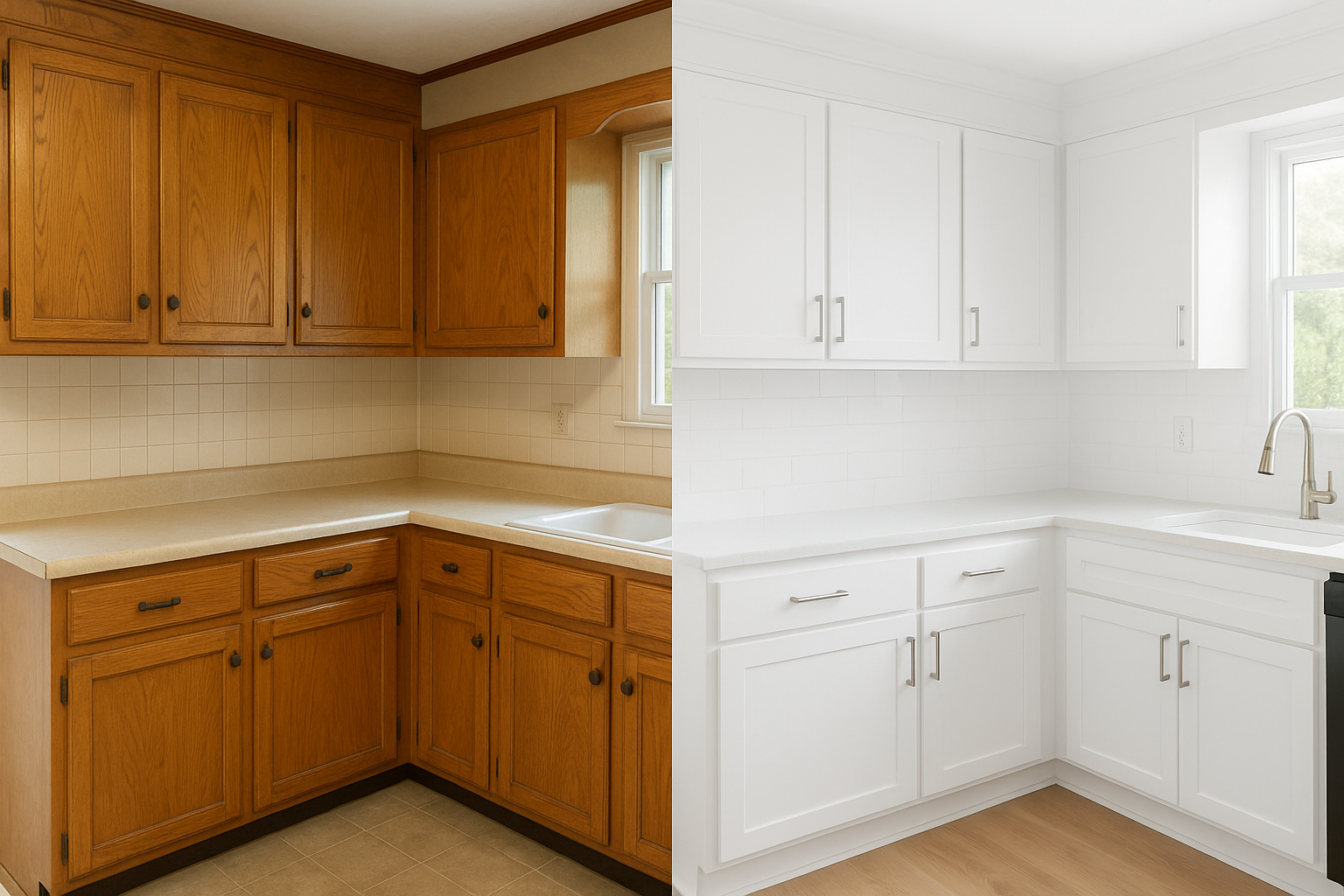
Cabinet refacing delivers a dramatic visual transformation while keeping waste to a minimum — a core benefit of choosing eco-friendly cabinet options.
Common Greenwashing Traps to Avoid
As consumer demand for eco-friendly cabinet options grows, so does the volume of vague, unverifiable “green” marketing language in the cabinetry industry. Knowing how to spot greenwashing protects you from paying a premium for sustainability claims that don’t hold up to scrutiny:
- “Eco-friendly” without certification: Any manufacturer can use this term without independent verification. Always ask which specific certification — FSC, GREENGUARD, CARB — backs the claim.
- “Natural” wood or finishes: Natural does not automatically mean sustainable or low-emission. Arsenic is natural; so is formaldehyde. Demand data, not adjectives.
- “Low-VOC” without measurement: “Low” is relative. Ask for the specific grams-per-liter VOC content of any finish product and compare it against recognized standards.
- “Sustainable sourcing” without chain-of-custody documentation: Without a documented trail from certified forest to your kitchen, a sustainability claim about wood sourcing is unverifiable.
- Focusing on one green attribute while ignoring others: A cabinet marketed as made from “recycled wood fiber” could still be finished with high-VOC lacquers and assembled with non-CARB-compliant adhesives. Evaluate the whole product, not a single feature.
Frequently Asked Questions About Eco-Friendly Cabinet Options
What are eco-friendly cabinet options?
Eco-friendly cabinet options are kitchen cabinet solutions designed to minimize environmental harm through sustainable material sourcing, low-emission finishes, and waste-reducing processes such as refacing. Examples include FSC-certified wood, bamboo, reclaimed timber, CARB-compliant composites, and thermally modified wood — all paired with low-VOC or zero-VOC finishes.
Why is cabinet refacing considered the greenest kitchen upgrade?
Cabinet refacing preserves the existing cabinet box structure, diverting hundreds of pounds of wood and composite material per kitchen from landfills. It also requires significantly less new raw material, less energy for manufacturing, and generates fewer transportation emissions than ordering an entirely new cabinet set — while costing 30 to 50 percent less than full replacement.
What is FSC-certified wood and why does it matter for eco-friendly cabinets?
FSC-certified wood comes from forests managed under strict environmental and social standards verified by the Forest Stewardship Council. For eco-friendly cabinet options, FSC certification provides documented assurance — through chain-of-custody records — that the timber was responsibly harvested in a way that protects biodiversity, respects worker rights, and prevents illegal deforestation.
Are bamboo cabinets truly sustainable?
Yes, bamboo is one of the most renewable cabinet materials available — it matures in three to five years compared to decades for most hardwoods, and it regenerates from its root system without replanting. However, always verify that bamboo cabinets carry CARB Phase 2 or GREENGUARD certification, since some bamboo products use formaldehyde-based adhesives in lamination that can compromise indoor air quality.
What does low-VOC mean in cabinet finishes, and how low is low enough?
VOC stands for volatile organic compound — chemicals in paints and finishes that evaporate at room temperature and degrade indoor air quality. Low-VOC finishes contain fewer than 50 grams per liter for flat formulas; zero-VOC finishes contain fewer than 5 g/L. For households with children, elderly occupants, or anyone with respiratory sensitivities, zero-VOC is the preferred standard for any eco-friendly cabinet project.
What is CARB compliance and why does it matter for composite cabinet materials?
CARB Phase 2 compliance means a composite wood product — MDF, particleboard, or plywood — meets the formaldehyde emission limits set by the California Air Resources Board. Formaldehyde is a known carcinogen that off-gasses from non-compliant panels for years after installation. Specifying CARB-compliant materials is the minimum health-protective standard for any eco-friendly cabinet project involving engineered wood.
What is thermally modified wood, and is it a good eco-friendly cabinet choice?
Thermally modified wood is lumber that has been heat-treated at high temperatures without any chemical additives. The process improves moisture resistance, dimensional stability, and rot resistance — making it ideal for kitchen environments — without toxic preservatives or off-gassing concerns. It is an emerging but increasingly accessible eco-friendly cabinet material for homeowners who want high performance alongside environmental integrity.
How much waste does cabinet refacing save compared to full replacement?
Cabinet refacing can divert hundreds of pounds of wood and composite material from landfills per kitchen project. Since existing cabinet boxes are kept intact, only door fronts and surface veneers are replaced, dramatically reducing the volume of construction debris generated. This makes refacing one of the most measurable waste-reduction strategies available in kitchen renovation.
What certifications should I look for when evaluating eco-friendly cabinet options?
For wood products, look for FSC certification with chain-of-custody documentation. For composite wood, require CARB Phase 2 compliance. For finishes and adhesives, prioritize GREENGUARD or GREENGUARD Gold certification. For a whole-product sustainability evaluation, Cradle to Cradle certification is the most comprehensive standard available. Always obtain written documentation rather than accepting verbal assurances.
How do I avoid greenwashing when shopping for sustainable cabinet materials?
Ask for specific certification names, certification numbers, and physical documentation for every green claim made about a cabinet product. Be skeptical of vague terms like “eco-friendly,” “natural,” or “sustainable” without accompanying third-party verification. Evaluate the full product — materials, adhesives, and finishes together — rather than accepting a single green attribute as proof of overall sustainability.
Can I get eco-friendly cabinet options in Cincinnati, Ohio?
Yes — Cincinnati homeowners can access high-quality eco-friendly cabinet options through local specialists like Kitchen Transformations Cabinet Refacing, which offers sustainable cabinet refacing services that reduce waste, use low-emission materials, and deliver a completely transformed kitchen without the environmental or financial cost of full replacement.
How long do eco-friendly refaced cabinets last?
Professionally refaced cabinets last 15 to 20 years or more with proper care. The longevity depends on the quality of materials selected and the skill of the installation. Because durability directly reduces the frequency of future renovation cycles — and the waste and resource consumption those cycles generate — investing in expert craftsmanship is itself a meaningful sustainability decision.
The Bottom Line: Making the Right Green Choice for Your Kitchen
Exploring eco-friendly cabinet options is one of the highest-leverage steps any homeowner can take toward a genuinely sustainable living space. From specifying FSC-certified wood and bamboo to insisting on zero-VOC finishes and CARB-compliant composites — and learning to identify greenwashing when you see it — every informed decision contributes to a healthier home and a lighter environmental footprint.
Above all, cabinet refacing remains the single most effective eco-friendly cabinet option for most homeowners: it produces the most dramatic waste reduction, delivers results visually indistinguishable from full replacement, and costs 30 to 50 percent less. When paired with certified sustainable materials, low-VOC finishes, and responsible disposal of removed components, it represents the gold standard in green kitchen renovation.
For Cincinnati homeowners ready to take that step, connecting with Kitchen Transformations Cabinet Refacing is the ideal starting point for a greener, more beautiful, longer-lasting kitchen. Author: Kitchen Transformations Cabinet Refacing. Last updated: 2026-07-08.